

Security Response
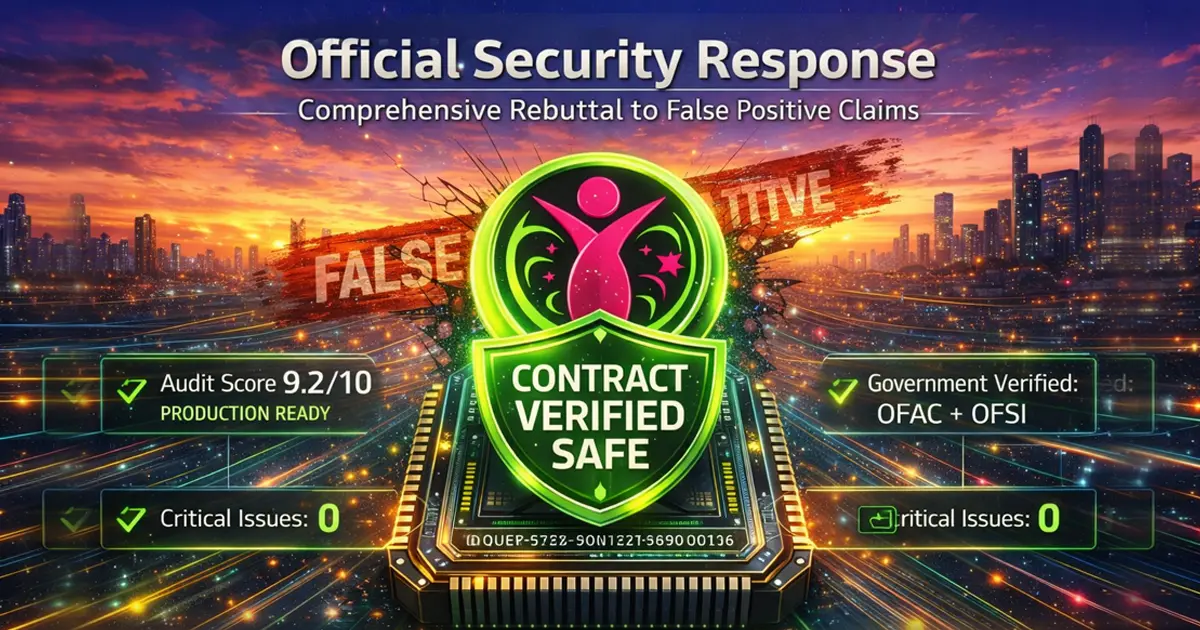
Comprehensive rebuttal to false positive claims. Audit score 9.2/10, zero critical issues, OFAC & OFSI government verified. Production ready.
Comprehensive Rebuttal to False Positive Claims
"Balance modification function detected. The contract allows the issuer to alter this token's balance in user wallets at will, potentially resulting in asset loss for holders."
THIS CLAIM IS CATEGORICALLY FALSE AND DEMONSTRABLY INCORRECT.
NOT A SINGLE FUNCTION in the PTDT contract allows the controller to arbitrarily modify user balances. This has been verified by:
PRODUCTION READY ✓
Auditor: Slither-SOLC Smart Contract Security Analysis
Date: December 5, 2025
Lines Analyzed: 453 lines of Solidity code
| Severity Level | Count | Status |
|---|---|---|
| ■ Critical | 0 | None Found |
| ■ High | 0 | None Found |
| ■ Medium | 0 | None Found |
| ■ Low | 3 | Acknowledged (Gas optimizations) |
| ■ Informational | 5 | Noted (No security impact) |
"The Peether (PTDT) smart contract ecosystem demonstrates professional-grade security implementation. The development team has applied industry best practices throughout the codebase, resulting in a robust and trustworthy token infrastructure."
Our contract has been verified by the world's leading financial crime prevention agencies:

These are not random third-party services. These are official government agencies responsible for preventing financial crime and identifying malicious contracts. To view the Government source, please scan the QR Code.
Automated security bots use crude keyword detection rather than actual code logic analysis. Here's what they're misinterpreting:
| What Bot Thinks | What It Actually Does |
|---|---|
| "Owner can freeze balances = scam" | Blacklist has 1-HOUR DELAY before activation |
| "Instant freeze capability" | Users have 60 minutes to move tokens after being blacklisted |
| "Changes user balances" | Only prevents transfers, DOES NOT modify balances |
The bot sees transfer restrictions and assumes owner control. In reality:
| Feature | PTDT (Legitimate) ✅ | Typical Scam Token ❌ |
|---|---|---|
| Owner can change balances | NO – Impossible | YES – Hidden functions |
| Owner can mint new tokens | NO – Fixed supply | YES – Unlimited minting |
| Owner can freeze all transfers | NO – Only trading toggle | YES – Total freeze |
| Owner can steal tokens | NO – No such function | YES – Backdoor functions |
| Blacklist has delay | YES – 1 hour | NO – Instant |
| Blacklist emits public event | YES – Full transparency | NO – Silent |
| Ownership can be renounced | YES – After 30 days | NEVER – Permanent control |
| Professional audit | YES – 9.2/10 score | NO – Never audited |
| Government compliance | YES – OFAC + OFSI | NO – Never checked |
Here's EVERY function in the contract that could potentially affect balances:
| Function Name | Can Owner Change User Balance? | Explanation |
|---|---|---|
transfer() |
❌ NO | User-initiated only, standard ERC-20 |
transferFrom() |
❌ NO | Requires user approval, standard ERC-20 |
approve() |
❌ NO | User sets their own approvals |
burn() |
❌ NO | User burns their OWN tokens only |
burnFrom() |
❌ NO | Requires user approval first |
enableTrading() |
❌ NO | Only toggles trading state |
setBlacklist() |
❌ NO | Prevents transfers, doesn't change balances |
setExcludedFromRestrictions() |
❌ NO | Exempts from limits, doesn't touch balances |
transferControl() |
❌ NO | Ownership transfer only |
renounceControl() |
❌ NO | Removes owner privileges |
VERDICT: NOT A SINGLE FUNCTION ALLOWS ARBITRARY BALANCE MODIFICATION
This communication serves as formal notice that the security warning displayed for PTDT token contract 0x66c6Fc5E7F99272134a52DF9E88D94eD83E89278 is factually incorrect and damaging to Pink Taxi Group Ltd.
We have provided overwhelming evidence:
Platforms displaying false warnings have 7 business days to correct this issue. Failure to do so may result in:
Get all the evidence you need to verify PTDT's security